

Home / Report to stakeholders / Feedlot
Feedlot
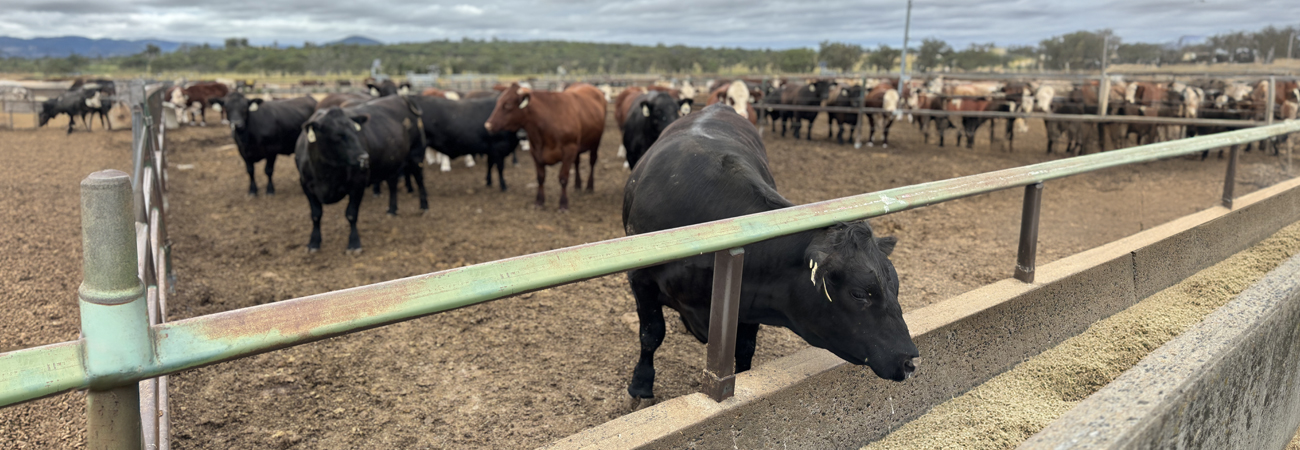
MLA’s feedlot program addresses the specific research, development and adoption requirements of the beef feedlot sector. Current investment priorities include:
- greenhouse gas suppressing technologies
- manure and effluent integrity and environmental management of covered housing systems
- investments in animal wellbeing and welfare assessment frameworks, vaccine development and shade and shelter adoption
- automation technology including autonomous feeding, health diagnosis and heat load prediction systems.
Outcomes
Bovaer®10 for backgrounding cattle
A recent trial of Bovaer®10 (3-NOP by DSM) when applied to a grain-based supplement has demonstrated dual methane reduction and productivity improvement benefits.
While there are currently multiple promising anti-methanogenic feed additives, their utilisation in extensive or pasture-based systems is limited due to lack of effective delivery methods and costs of daily supplementation.
This project aimed to develop a pellet attractive enough to ensure multiple feeding bouts throughout the day with the aid of automated pellet delivery on pasture. The stability of 3-NOP through pelleting and storage was assessed in addition to various feed delivery protocols. A 150-head grazing trial was conducted to quantify methane emissions and animal growth impacts when supplementing with energy pellets containing Bovaer®10.
The study demonstrated a 6.6% increase in average daily weight gain and a 25% reduction in emissions when compared to the control group. Once extrapolated, this delivered an increased growth rate with Bovaer®10 equal to a potential 28-day reduction to the number of grazing days and reduced enteric methane emissions of 340.5 kg CO2-eq/head over the backgrounding period.
Asparagopsis trials
MLA recently concluded two studies into the efficacy and safety of Asparagopsis extract in a canola oil carrier.
The first study measured the methane reduction potential and safety of Asparagopsis extract oil in a trial with 20 Angus heifers, fed feedlot diets containing three different levels of oil to deliver the corresponding bromoform. Compared to the control animals, inclusion levels of low, medium, and high bromoform (17, 34 and 51mg bromoform/kg DM) from Asparagopsis oil respectively reduced CH4 yield (g CH4 /kg DMI) by 54.5, 85.2 and 95%.
The study revealed no effects on animal production or carcase characteristics and no impacts on animal health, welfare or rumen function. Carcase samples contained levels of iodine and bromide that were either no different to the control or were safe for human consumption, and there was no bromoform detected in any carcase samples. The study overall confirmed Asparagopsis extract oil to be effective for reduction of CH4 emissions and safe for animals and consumers of meat and edible offal.
The second study sought to understand the methane reduction achievable in a long-fed Wagyu production system and implications for cattle feedlot performance, carcase grading, residues and sensory panel evaluations in what stands as the longest feeding trial (275-day feeding period) of an Asparagopsis product to date. Compared to the control, animals fed Asparagopsis oil (25mg bromoform kg/DM) reduced CH4 production by 28% over the whole feeding period with a 22% decrease in methane yield (g/kg DMI).
However, Asparagopsis oil also reduced feed intake consistently without improvement in feed efficiency. This resulted in persistently reduced liveweight gain and a trend to reduce carcase weight. Due to the decline in liveweight, methane intensity (g/kg LW gain) did not differ between treatments.
Other carcase grading traits were not affected by Asparagopsis oil supplementation. There was no effect on trained sensory panel attributes and, consistent with other research, there was no bromoform detectible in meat or offal. Canola oil stabilised bromoform over the duration of this study with no volatilisation evident in vegetable oil tanks at the feedlot.
It is important to note this is a single experiment from a single market category of feedlot cattle. Further research independent of MLA is planned to be delivered by the Federal Government MERIL grants program to determine the responses of Asparagopsis in other feedlot diets.
Further research is required to refine feeding protocols for Asparagopsis oil supplements to overcome intake depression in Wagyu cattle. This may not be unique to Asparagopsis and should consider not only dose rates and adaptation protocols, but potentially co-feeding of hydrogen sinks or products that promote hydrogen utilisation in the rumen together with methane inhibitors.