

Home / Report to stakeholders / Capability building
Capability building
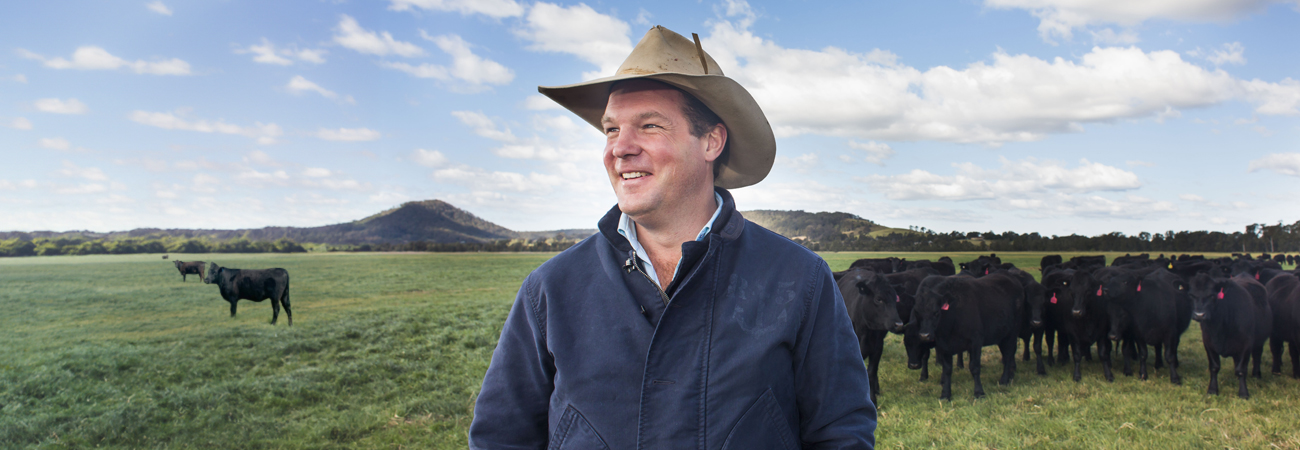
MLA’s capability building program invests in current and emerging industry leaders, innovators, scientists and value chain participants to enhance professional leadership and business skills. This investment helps accelerate industry adoption of research outcomes and positively contributes to holistic sustainability.
Outcomes
CN30 Co-Innovation Program
MLA has specifically developed a partnership program to support leading supply chains to:
- test carbon neutral by 2030 (CN30) tools and technology
- accelerate their carbon management strategies through a structured and supported co-innovation program.
The program complements company resources over the three-year partnership to explore, pilot and scale greenhouse gas management interventions at the enterprise level. Through these investigations, leading supply chains can build their own capability and in turn accelerate the adoption of technology and tools across industry.
The supply chain partners currently involved in the collaborative program include Australian Country Choice, Paraway Pastoral Company, Argyle Foods group, Casino Foods Co Operative and Hewitt Cattle Company. Collectively these partners represent 965,000 cattle, 413,000 sheep over an area of 9.5 million hectare under management.
The exclusive focus of these partnerships is to explore, pilot and scale GHG management interventions through the development and implementation of an innovation strategy containing the following work areas of emissions avoidance, carbon storage, integrated management systems and leadership building as outlined in the industry’s CN30 Roadmap.
Two years into the program and all partners have successfully completed their initial supply chain carbon baseline measurement activity within the strategy development framework.
Read on for summaries of each partner’s involvement in the program.
Argyle Foods Group – Argyle Pastoral
Argyle Foods Group is an integrated Australian agricultural company comprising of Argyle Pastoral, Argyle Carbon and Argyle Meats. Argyle Pastoral is a consolidated beef producer focused on integrating across the property portfolio high impact carbon, biodiversity, and renewable energy projects alongside a sustainable beef supply chain.
Argyle has taken a multi-pronged approach to pursuing carbon neutrality, including:
- measuring and verifying baseline emissions and potential Australian Carbon Credit Units through the Clean Energy Regulator
- measuring baseline emissions profile and assessing the feasibility of carbon neutrality through a Life Cycle Analysis with a qualified external organisation to supplement the need for environmental data by identifying emissions sources within the Argyle business.
Argyle Pastoral achievements to date include:
- development of three Emissions Reduction Fund projects for approval by the Clean Energy Regulator including a beef herd management project, a soil carbon project and an environmental plantings project
- implemented initiatives to increase soil organic carbon on a holding by 1.5%
- developed and launched a new regenerative beef brand ‘Argyle Nurture’ which is resonating positively with national and international consumers.
Australian Country Choice
Australian Country Choice (ACC) is Australia’s largest vertically integrated beef supply chain. The priority for ACC is to better understand abatement and sequestration boundaries and opportunities for their supply chain. ACC continues to expand their CN30 co-innovation program to explore, pilot and scale greenhouse gas management interventions to deliver positive environmental, economic and social impacts across their supply chain and the Australian red meat industry.
ACC achievements to date or in process include:
- development of a CN30 Innovation Plan including baselines for the ACC supply chain to understand footprint and abatement priorities
- development of key performance indicators and measurement systems against baselines for all key focus areas
- registration of a herd management project with the Clean Energy Regulator
- development of Power BI reports to monitor the Beef Herd Management Project (BHMP)
- mapping farmland to understand land types to prioritise soil and natural resource abatement opportunities
- development of a Human Induced Regeneration plan for ACC
- broader understanding of biodiversity options.
Casino Foods Co Operative (NCMC)
Casino Foods Co-Operative (NCMC) is Australia’s largest producer-owned meat processing co-operative. The priority for NCMC is to develop carbon management capability, to interrogate and enable the generation of carbon credits from their producer members. The program will include the development of a methodology that supports a modelled approach to estimating soil organic carbon change that will deliver a more cost-effective alternative to verify the change needed for carbon markets.
NCMC achievements to date include:
- review of all applicable soil and vegetation carbon methodologies for Casino Food Co-op and soil turnover models with the objective of determining the optimal soil carbon method and one suitable vegetation carbon method that could be applied to multiple farms within the Northern Rivers region
- completion of a high-level carbon footprint of the Casino Food Co-op supply chain
- pilot soil carbon change across a select group of Casino Food Co-op member farms
- design of a carbon sequestration program which is being extended to co-op members more broadly.
Hewitt Foods – Hewitt Cattle Company
Hewitt Foods is a global food producer with an integrated and ethical supply chain.
Hewitt Cattle Company is pursuing significant sustainability, regenerative agriculture and emission reduction opportunities for the supply chain, including potential to certify performance for marketing purposes.
It is the first program in Australia at this scale covering all these elements of emissions reduction including:
- insetting and offsetting
- biodiversity and natural capital improvements
- regenerative agriculture practices.
The program is expected to deliver both research and practical adoption outcomes across central and eastern Australia supply chains.
This partnership will demonstrate how combined ESG actions (carbon, biodiversity, natural capital and regenerative agriculture) can be successfully implemented, monetising red meat supply chains through the development of carbon and environmentally branded red meat products.
Hewitt Cattle Company achievements to date include:
- completed carbon footprint for the Hewitt Cattle supply chain (scopes 1, 2 and 3), covering Hewitt operations (stations and facilities)
- carbon footprint assessment for its five biggest producers
- completion of carbon footprint for third party purchased cattle and sheep across 10 representative beef producers and 10 representative lamb producers
- establishment of a baseline profile of biodiversity, natural capital and regenerative agriculture
- established targets, timelines and scale of identified sustainability strategies for the supply chain
- pre-feasibility assessments of soil and vegetation/stacking (insetting and offsetting) options for the supply chain
- delivery of an emissions reduction and sustainability improvement strategy for direct controlled and third-party cattle and sheep suppliers.
Paraway Pastoral Company Ltd
Paraway Pastoral Company Ltd is a private company which owns and operates large-scale sheep and cattle operations across eastern Australia. The company currently operates 27 pastoral enterprises across several diversified climatic zones and a range of country types. Collectively the portfolio of properties carries over 220,000 cattle and 250,000 sheep and presents an important value chain partnership given the scale and regional diversity of the enterprise.
Paraway Pastoral’s priority is to explore, pilot and scale greenhouse gas management interventions. Project success is a net zero warming position, which includes a 30% reduction in methane intensity and net zero CO2 emissions, providing key insights and case study learnings for wider industry.
Paraway Pastoral’s achievements to date include:
- establishment scope 1 and 2 baseline emissions for livestock and cropping enterprises
- developed station specific emission reduction targets and mitigation strategies
- development of human-induced regeneration projects (environmental planting and biodiversity)
- development and registration of beef herd projects with the Clean Energy Regulator
- pilot conversion of station compound generators to solar hybrid systems
- commenced utilising sexed semen for the terminal F1 Wagyu program, which aims to maximise the number of steer progeny with faster growth rates that will be turned off quicker, therefore reducing emissions
- registration of soil carbon project at Gregory Downs in association with QUT and Agrimix using flux tower technology
- methane emission calculation methodology updated to allow farm scale inputs rather than national or state-based coefficients.